







Five Principles

A Human‑First Approach to Addressing Homelessness

A clear, coordinated, and compassionate framework for helping people move from the street into stability, recovery, and
productive lives in Multnomah County.

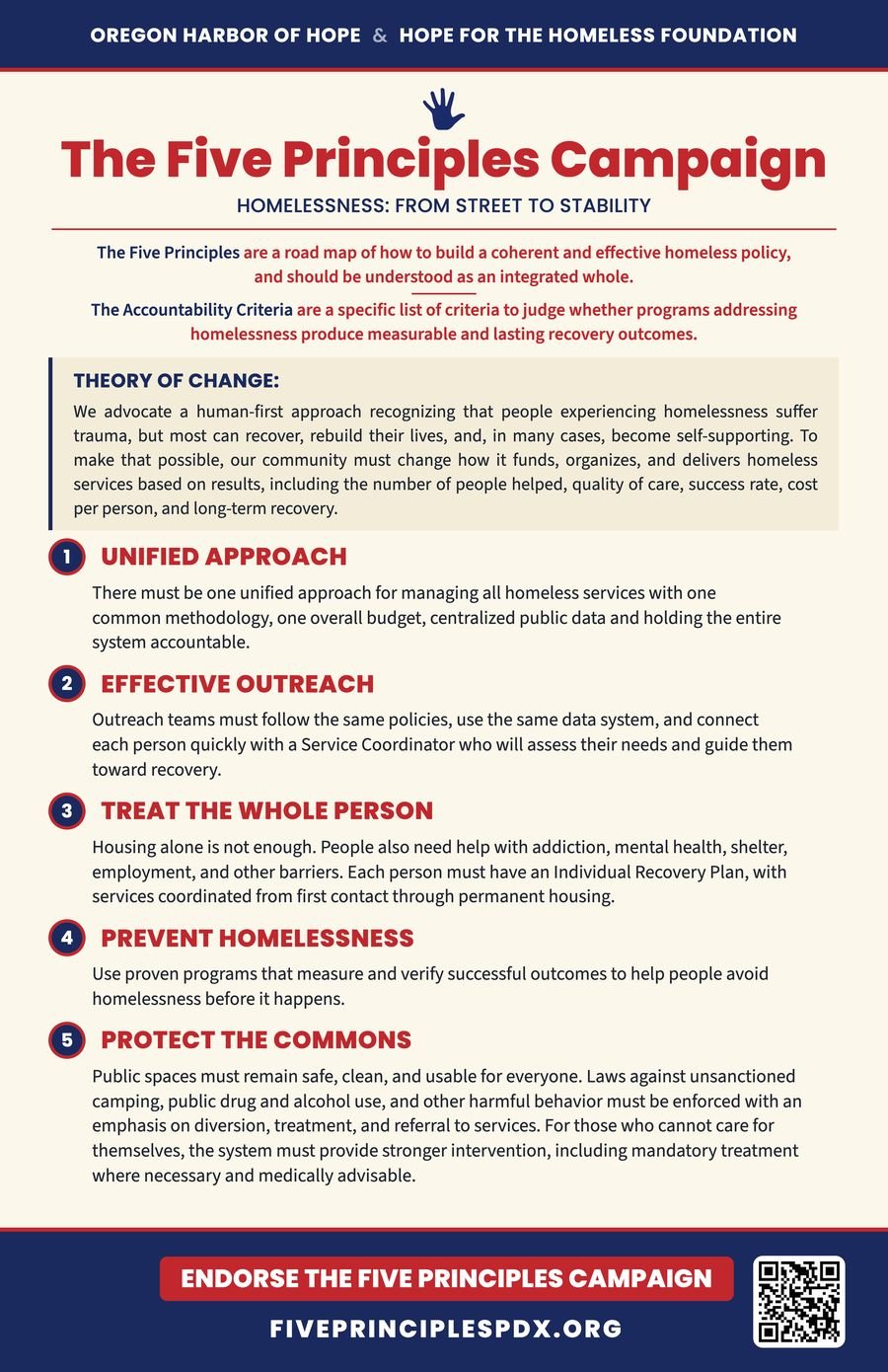
The Five Principles outline a human‑first, outcomes‑driven approach to addressing homelessness in Multnomah County. They call for unified leadership, coordinated outreach, whole‑person care, evidence‑based prevention, and the protection of our shared public spaces. This framework represents a fundamental shift in how budgets, policies, and programs are structured  replacing fragmented efforts with a single, accountable system that leads with compassion and measurable results.

Theory Of Change

We advocate a human-first approach recognizing that all who are homeless experience trauma, but all have the capacity to change, including, in many cases, supporting themselves without subsidy. This requires a fundamental shift in budgets, policies, and programming.

1. Unified leadership

A single entity with professional leadership to supervise and coordinate all activities addressing homelessness in
Multnomah County, utilizing an integrated methodology and global budget.

2. Outreach

Consistent policies, procedures and data input must be implemented across all outreach efforts. At first contact,
outreach workers should introduce individuals to a Service Coordinator Specialist (SCS) to identify their needs, the services and programs available to them, and to chart a path to recovery.

3. Treat the Whole Person

Both treatment and housing in a comprehensive approach are necessary for success. A list (by name) outlining each client’s needs and tracking their path towards recovery from first outreach through each
later contact, available to and used by all service providers, as a key step toward development of an Individual Recovery Plan. Build a seamless continuum of services to provide detox, mental illness stabilization, physical shelter, transitional
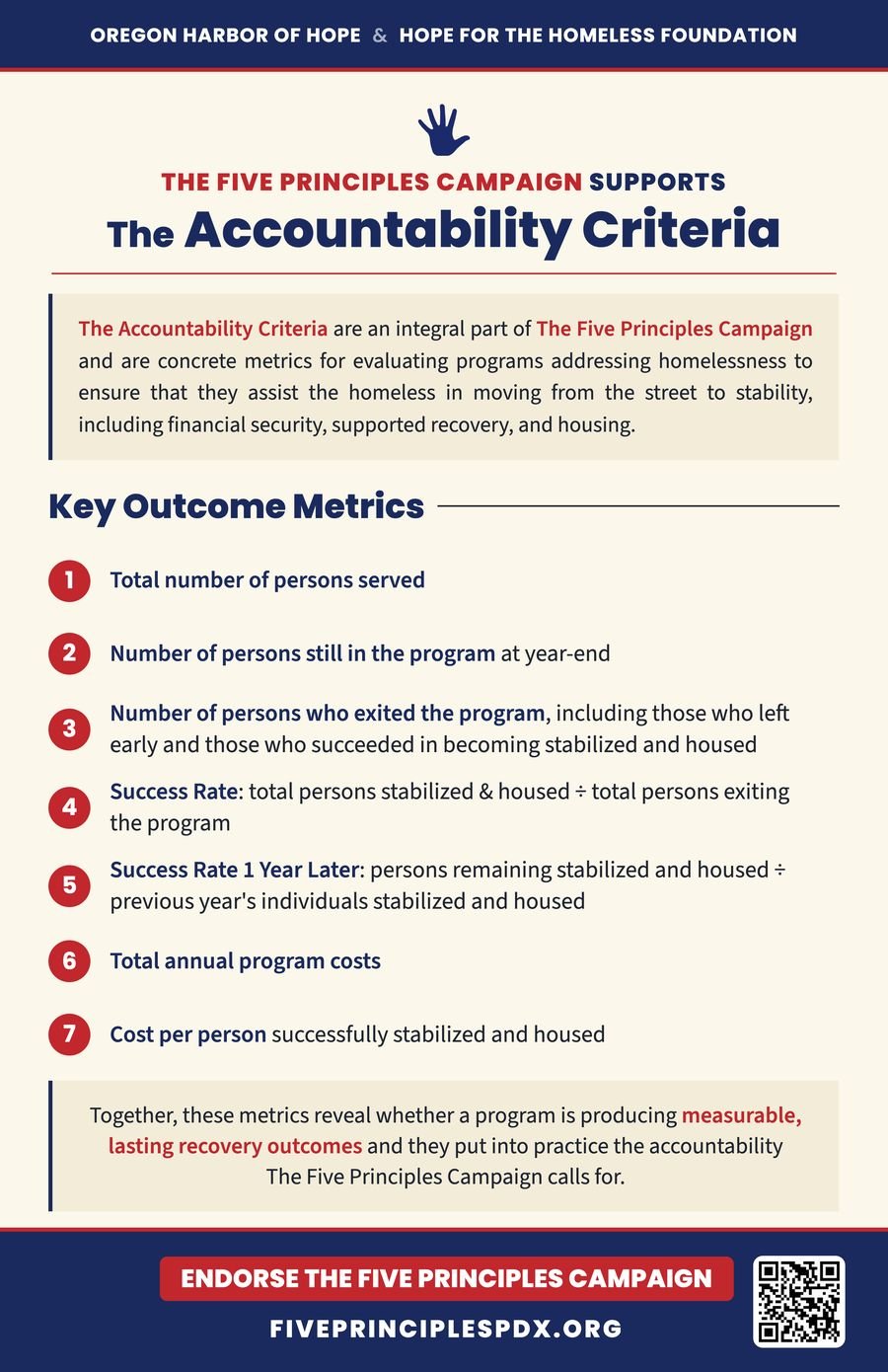
shelter, permanent housing, and employment assistance, matching the individual with the level and type of service they need at each step of recovery without timing gaps between the end of one service and the beginning of the next. Governmental, church or nonprofit organizations should utilize outcome-based contracts to award funding, including metrics that address quality of care, the number served, cost per person, and the path to move individuals to recovery, and they should review each contract annually based on the agreed outcomes to determine whether funding should continue.

4. Prevent Homelessness from Occurring

Use evidence-based programs to prevent people from falling into homelessness and outcome-based evaluation of such
programs.

5. Protect the Commons

Respectful enforcement of laws against unsanctioned camping, drug and alcohol use, emphasizing deflection, diversion, and mandatory referral to services. Minimize the impact on the general public’s safety and quality of life. Implement court-mandated drug withdrawal programs. Modify civil commitment laws and guidelines to ensure that individuals who are unable to care for themselves are not left untreated on the street. Failure to protect the Commons results in businesses closing and taxpayers moving away, leaving less money for
homeless programs and other government services.

Endorse The Five Principles

The Five Principles offer a clear, coordinated, and compassionate path forward for Multnomah County. Endorsing this
framework signals your support for a system that treats people with dignity, aligns resources under unified leadership,
and ensures accountability for real outcomes.
Join community members, organizations, and leaders who believe Multnomah County can and must do better.

ORGANIZATIONS ENDORSING THE FIVE PRINCIPLES

Unified System
0
Organizations Aligned
0 +
Core Principles
0

Unified Leadership, Lasting Impact

The Five Principles creates a coordinated, trauma-informed system where every person has the capacity to recover when supported. By aligning leaders and partners around shared accountability, we transform fragmented services into seamless pathways to recovery. Our approach bridges compassion with measurable outcomes, ensuring Portland’s communities receive consistent, dignified support.

Why We Need the Five Principles​

Multnomah County homeless policies summary:

  • Homeless are helpless victim needing charity
  • Record spending, more homelessness
  • Plan to continue failed policies with less money
  • “Insanity is doing the same thing over and over and expecting differentresults”

Five Principles

  • Homeless are citizen deserving respect, have rights as well asresponsibilities
  • “Success” is return to productive life
  • Not policy specific, but results oriented
  • Takes whole person, and whole community, into account

Constant Increase in Homelessness ​

  • Homelessness increasing by1.9% per month in MultnomahCounty despite record spending
  • Government and serviceproviders see this as proof weneed more money
  • We see this as evidence ofPOLICY FAILURE

Order of Magnitude More Homelessness in Multnomah County​


  • Why does Multnomah County have
    9x to 13x the homeless rate of
    Metro neighbors?​

  • Clackamas, Washington Counties
    treat the homeless as citizens
    who need help: Compassionate
    Respect​

  • Multnomah County treats
    homeless as helpless victim who
    need charity: Compassionate
    Neglect​

  • No responsibility to help themselves​

Example: “Compassionate Neglect” versus “Compassionate Respect”

Multnomah County Deflection Center Compassionate Neglect

Washington County Deflection Center

Compassionate Respect

Person can walk out, no consequences

If person walks out, they go to jail

If they stay, given list of providers

If they stay, choose from list of providers

If they call on provider, it is listed as “success”

Escorted to provider, enrolled by case manager

No follow up, no record of use or completion of services

Case manager follows up monthly, attends graduation

Multnomah County Policies Fail by Its Own Standards

  • Multnomah County practices “Housing First”
  • Actually is “Housing Only”, providing housing with minimal support
  • “Success” is measure by placement into permanent housing
  • HSD Shelter Report: 15% of exits from shelter are to permanenthousing, i.e. “successful” 
  • HSD Dashboard: Of “chronically homeless”:
  • 2,112 “ exited homelessness to permanent housing in 2025
  • But 1,328 (63%) “returned to homelessness from permanent housing”

  • By their own standards MultCo homeless policies are failing

(1) Unified leadership, one coordinated system, one accountable budget

  • Currently Metro, Multnomah County and the City of Portland each have
    their own bureaucracies, priorities, budgets, and programs to address
    homelessness. The result is program duplication, gaps in treatment,
    waste, and little progress. Without unified leadership the best intentions
    and policies will not be effective.

(2) Coordinated outreach that connects people with healthcare, counselling, housing, benefits, and a clear path forward.

  • Currently street outreach to the homeless is split among over 20 different
    organizations, each with its own policies. A few work to get the homeless
    into the right services, some only do “harm reduction” by giving out tents
    and straws and needles, some do a mix. There is little coordination or
    accountability for results.

(3) Housing and treatment together, tailored to the individual’s needs, guided by data, outcomes, and individual recovery plans (IRPs).

  • Each individual has unique needs, which need to be assessed,
    documented, and their treatments need to be tracked. The current system
    mandates that everyone be put into an apartment with minimal supervision
    or support, whether they (or their neighbors, or the landlords) are ready or
    not. This results in very high return to homelessness rates and damaged
    properties.

(4) Use evidence-based methods to prevent people from falling into homelessness and evaluate such programs with outcome-based criteria.

  • Much funding goes into homeless prevention programs such as rent-
    support, eviction-prevention programs, prisoners returning to society, and
    aging out of foster care. While all are worthy efforts, funding is limited and
    there is little data to show which are most cost-effective in preventing
    actual homelessness.

(5) Safe, clean public spaces for everyone, supported by consistent laws and supporting interventions.

  • Without safe streets, individuals and businesses leave the city. Without
    those taxpayers we cannot fund homeless services, or other services for
    our neediest citizens.
Endorse The Five Principles:
Add your name, or your organization’s name to the growing list of supporters committed to a unified, human‑first approach to homelessness.
Example: info@fiveprinciplespdx.org
Example: Director or Executive, Manager etc
Sign-up for Portland Voice Newsletter

“Compassion and accountability are not opposites, they are partners.”

Contact Us

Address

1616 NW 13th avenue Portland 97209

Phone

+1 (503) 928-6920

Email

info@fivepriciplespdx.org

© The Five Principles 2026. All rights reserved.