







Advocacy program

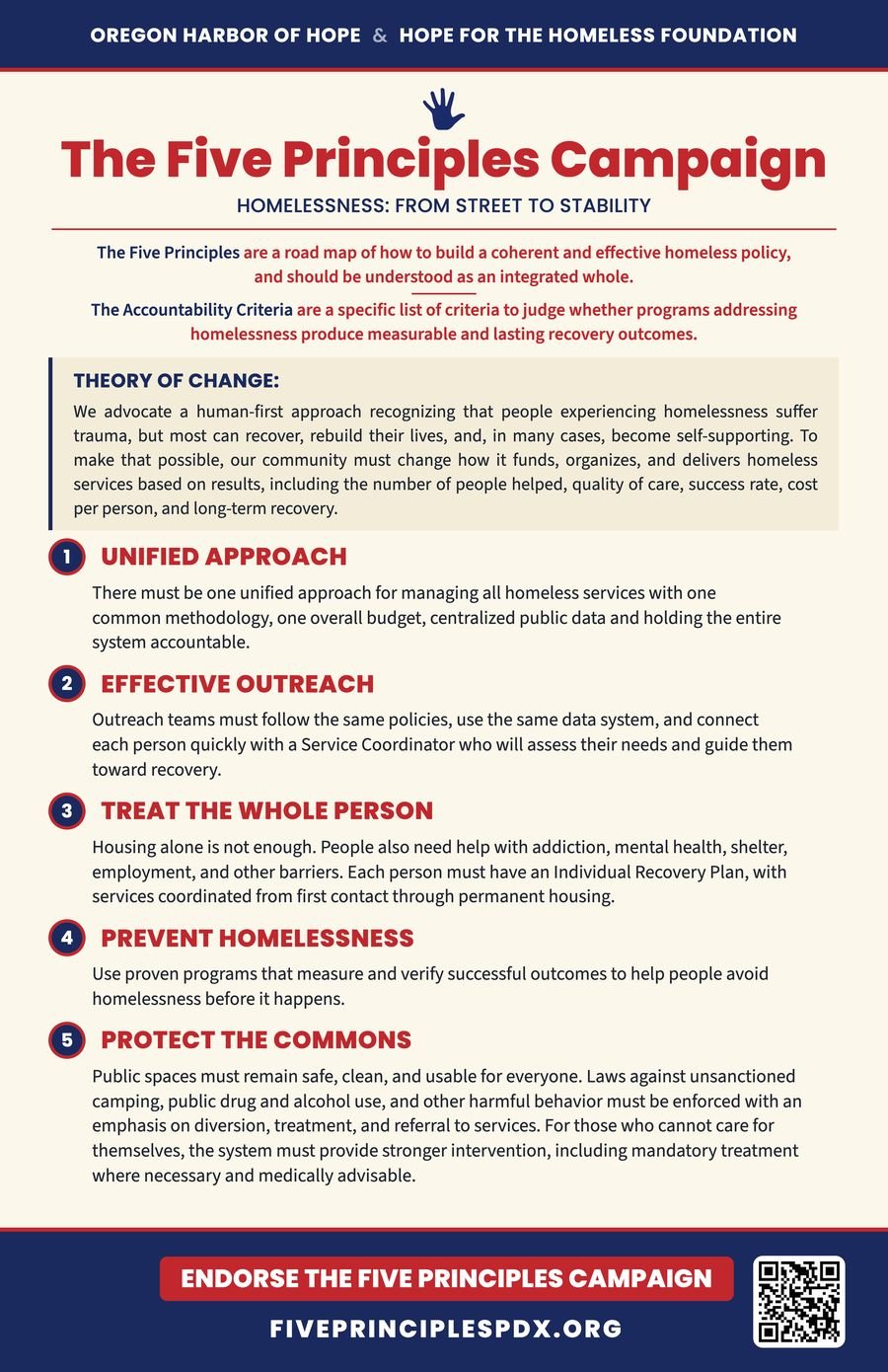
The Five Principles Campaign

Homelessness: From Street to Stability

The Five Principles are a road map of how to build a coherent and effective homeless policy, and should be understood as an integrated whole.

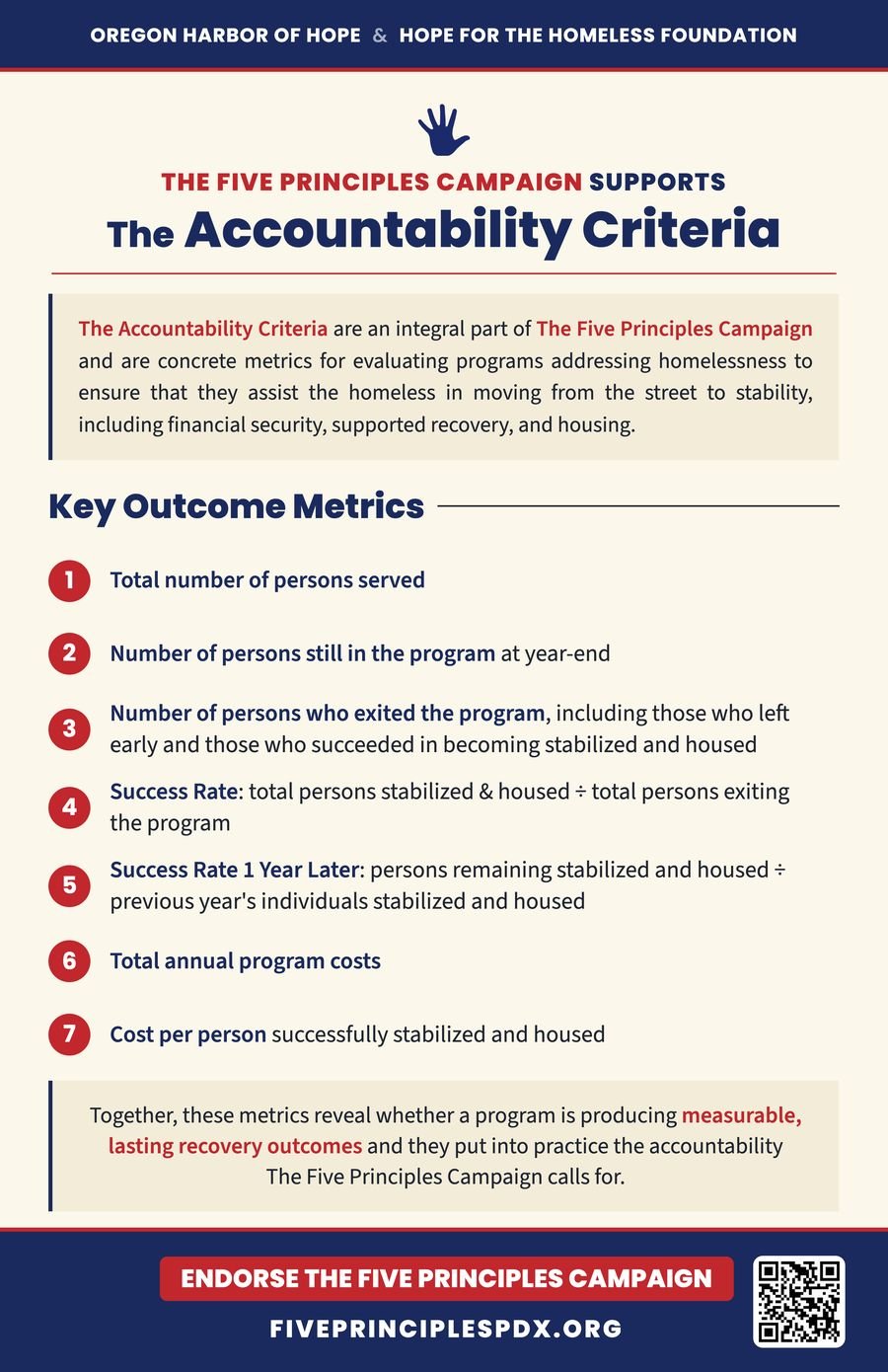
The Accountability Criteria are a specific list of criteria to judge whether programs addressing homelessness produce measurable and lasting recovery outcomes.

A campaign of Oregon Harbor of Hope and Hope for the Homeless Foundation. Everything Oregon Harbor of Hope does is in the name of The Five Principles.

The Five Principles Campaign poster
Theory of change

Most people can recover.

We advocate a human-first approach recognizing that people experiencing homelessness suffer trauma, but most can recover, rebuild their lives, and, in many cases, become self-supporting. To make that possible, our community must change how it funds, organizes, and delivers homeless services based on results, including the number of people helped, quality of care, success rate, cost per person, and long-term recovery.

Compassion and accountability are not opposites, they are partners.

Two women embracing

The Five Principles outline a human-first, outcomes-driven approach to addressing homelessness in Multnomah County. They call for a unified approach, coordinated outreach, whole-person care, evidence-based prevention, and the protection of our shared public spaces. This framework represents a fundamental shift in how budgets, policies, and programs are structured: replacing fragmented efforts with a single, accountable system that leads with compassion and measurable results.

Why we need The Five Principles

Record spending. More people on the street.

Multnomah County spends more on homelessness every year, and homelessness keeps rising, about 1.9 percent a month. The county's rate of homelessness is nine to thirteen times that of Clackamas and Washington counties next door. The money is not the problem. The system is.

Today's approach treats people experiencing homelessness as victims who need charity, measures activity instead of results, and holds no one accountable when the numbers go the wrong way. We call it compassionate neglect.

The Five Principles ask for compassionate respect: treating people as citizens with rights and responsibilities, measuring success by the return to a stable, productive life, and organizing the whole system around that result.

Downtown Portland and the Willamette River at sunset
Multnomah County homeless numbersFrom the county By-Name List 10,000 11,000 12,000 13,000 14,000 15,000 16,000 17,000 18,000Jan-24Apr-24Jul-24Oct-24Jan-25Apr-25Jul-25Oct-25Dec-25 17,50011,450 January 2024 to December 2025Increased 1.9 percent per monthSource: Multnomah County By-Name List
Constant increase in homelessness

1.9 percent a month, despite record spending.

  • Homelessness is increasing by 1.9 percent per month in Multnomah County despite record spending
  • Government and service providers see this as proof we need more money
  • We see this as evidence of policy failure
Order of magnitude more homelessness

Why does Multnomah County have 9 to 13 times the homeless rate of its Metro neighbors?

  • Clackamas and Washington Counties treat the homeless as citizens who need help: compassionate respect
  • Multnomah County treats the homeless as helpless victims who need charity: compassionate neglect
  • No responsibility to help themselves
Homeless people per 1,000 residentsJanuary 2025 0 4 8 12 16 20 1.3ClackamasPoint-in-Time 1.5WashingtonPoint-in-Time 13.2MultnomahPoint-in-Time 18MultnomahBy-Name ListPoint-in-Time counts and Multnomah County By-Name List, per 1,000 residents
An example

"Compassionate neglect" versus "compassionate respect"

Compassionate neglect

  • People are helpless victims who need charity
  • Record spending, rising homelessness
  • Plan to continue failed policies with less money
  • Success measured by services delivered
  • No one accountable for results

Compassionate respect

  • People are citizens deserving respect, with rights as well as responsibilities
  • "Success" is a return to a productive life
  • Not policy specific, but results oriented
  • Takes the whole person, and the whole community, into account
  • Results published, and someone responsible for them

The deflection centers, side by side

Multnomah County Deflection CenterCompassionate neglect Washington County Deflection CenterCompassionate respect
Person can walk out, no consequences If the person walks out, they go to jail
If they stay, given a list of providers If they stay, they choose from a list of providers
If they call on a provider, it is listed as "success" Escorted to the provider, enrolled by a case manager
No follow up, no record of use or completion of services Case manager follows up monthly, attends graduation
Downtown Portland from above
The Five Principles Campaign

Multnomah County policies fail by their own standards.

  • Multnomah County practices "Housing First"
  • Actually it is "Housing Only", providing housing with minimal support
  • "Success" is measured by placement into permanent housing
  • HSD Shelter Report: 15 percent of exits from shelter are to permanent housing, i.e. "successful"
  • HSD Dashboard: of the "chronically homeless," 2,112 "exited homelessness to permanent housing" in 2025
  • But 1,328 (63 percent) "returned to homelessness from permanent housing"

By their own standards, Multnomah County homeless policies are failing.

The road map

The Five Principles

A road map of how to build a coherent and effective homeless policy, and should be understood as an integrated whole.

  1. 01

    Unified Approach

    There must be one unified approach for managing all homeless services with one common methodology, one overall budget, centralized public data and holding the entire system accountable.

  2. 02

    Effective Outreach

    Outreach teams must follow the same policies, use the same data system, and connect each person quickly with a Service Coordinator who will assess their needs and guide them toward recovery.

  3. 03

    Treat the Whole Person

    Housing alone is not enough. People also need help with addiction, mental health, shelter, employment, and other barriers. Each person must have an Individual Recovery Plan, with services coordinated from first contact through permanent housing.

  4. 04

    Prevent Homelessness

    Use proven programs that measure and verify successful outcomes to help people avoid homelessness before it happens.

  5. 05

    Protect the Commons

    Public spaces must remain safe, clean, and usable for everyone. Laws against unsanctioned camping, public drug and alcohol use, and other harmful behavior must be enforced with an emphasis on diversion, treatment, and referral to services. For those who cannot care for themselves, the system must provide stronger intervention, including mandatory treatment where necessary and medically advisable.

What each principle means in practice

Where Portland stands today, and what has to change.

1
Unified Approach

One coordinated system, one accountable budget

Currently Metro, Multnomah County and the City of Portland each have their own bureaucracies, priorities, budgets, and programs to address homelessness. The result is program duplication, gaps in treatment, waste, and little progress. Without a unified approach the best intentions and policies will not be effective.

2
Effective Outreach

Coordinated outreach that connects people with healthcare, counselling, housing, benefits, and a clear path forward

Currently street outreach to the homeless is split among over 20 different organizations, each with its own policies. A few work to get the homeless into the right services, some only do "harm reduction" by giving out tents and straws and needles, some do a mix. There is little coordination or accountability for results.

3
Treat the Whole Person

Housing and treatment together, tailored to the individual's needs, guided by data, outcomes, and Individual Recovery Plans (IRPs)

Each individual has unique needs, which need to be assessed, documented, and their treatments need to be tracked. The current system mandates that everyone be put into an apartment with minimal supervision or support, whether they (or their neighbors, or the landlords) are ready or not. This results in very high return to homelessness rates and damaged properties.

4
Prevent Homelessness

Use evidence-based methods to prevent people from falling into homelessness and evaluate such programs with outcome-based criteria

Much funding goes into homeless prevention programs such as rent support, eviction prevention programs, prisoners returning to society, and aging out of foster care. While all are worthy efforts, funding is limited and there is little data to show which are most cost-effective in preventing actual homelessness.

5
Protect the Commons

Safe, clean public spaces for everyone, supported by consistent laws and supporting interventions

Without safe streets, individuals and businesses leave the city. Without those taxpayers we cannot fund homeless services, or other services for our neediest citizens.

Housing alone is not enough. Recovery takes all five principles working together, funded by results, not intentions.

Add your name to The Five Principles.

Organizations and individuals across Portland have endorsed. It takes two minutes, and every name strengthens the case we make to county and city leaders.

The Accountability Criteria poster

Measuring what matters: which programs are actually working?

Hope for the Homeless Foundation evaluates programs by measurable outcomes, financial accountability, and their ability to help individuals address the underlying causes of homelessness, become stabilized, and transition into permanent housing.

We hold ourselves to the same standard. First Step, our reentry program, reports these same metrics for the women we serve.

The Five Principles Campaign supports

The Accountability Criteria

The Accountability Criteria are an integral part of The Five Principles Campaign and are concrete metrics for evaluating programs addressing homelessness to ensure that they assist the homeless in moving from the street to stability, including financial security, supported recovery, and housing.

Key Outcome Metrics

  1. 1

    Total number of persons served

  2. 2

    Number of persons still in the program at year-end

  3. 3

    Number of persons who exited the program, including those who left early and those who succeeded in becoming stabilized and housed

  4. 4

    Success Rate: total persons stabilized & housed ÷ total persons exiting the program

  5. 5

    Success Rate 1 Year Later: persons remaining stabilized and housed ÷ previous year's individuals stabilized and housed

  6. 6

    Total annual program costs

  7. 7

    Cost per person successfully stabilized and housed

Together, these metrics reveal whether a program is producing measurable, lasting recovery outcomes and they put into practice the accountability The Five Principles Campaign calls for.

The partnership

Two organizations, one conviction: recovery should be measured by results.

Oregon Harbor of Hope has spent 10 years creating a bridge for people returning from long-term incarceration and for communities impacted by homelessness, while developing The Five Principles, a human-first framework for how homeless services should be funded, organized, and delivered.

Hope for the Homeless Foundation, led by Doug Marshall, brings a powerful complement through its Accountability Criteria: measurable standards HHF has used for years to identify and fund the nonprofits most effective at helping homeless people achieve lasting stability.

Together, OHOH and HHF share a conviction that Portland can build a system worthy of the people it serves.

Press release, Portland, July 22, 2026: Oregon Harbor of Hope and Hope for the Homeless Foundation launch a campaign to set a new standard for homeless services in Portland.

Many hands stacked together

"You build a city by building up the people in it."

Homer Williams, Founder, Oregon Harbor of Hope
Who has endorsed

Organizations aligned with The Five Principles.

Nonprofits, businesses, and community groups across Portland have added their name. Join them.

A group of people in a huddle, laughing
Oregon Harbor of Hope
Hope for the Homeless Foundation
Portland Voice
Peer 2 Peer Portland
Good Circumstance
Going Home II
Go Portland Go
Ankeny Live/Work LLC
My Father's House
Pearl District Neighborhood Association
Purposeful Venture
Great Harvest

Organizations

  • Oregon Harbor of Hope
  • Hope for the Homeless Foundation
  • Portland Voice
  • Peer 2 Peer Portland
  • Good Circumstance
  • Going Home II
  • Go Portland Go
  • Ankeny Live/Work LLC
  • My Father's House
  • Pearl District Neighborhood Association
  • Purposeful Venture
  • Great Harvest

Individuals

  • Homer Williams
  • Patrizia Montanari
  • Michael Royce
  • Karl Mautner
  • Rob Justus
  • Gary Mittelstaedt
  • David Richardson
  • Daren Connor
  • Annie Barry
  • Lance Orton
  • Doug Marshall
  • George Feldman
  • Roberta Lampert
  • Nicole Tignor Zimmerman
  • Les Swanson Jr
  • Terry Rogers
  • Jay Harris
  • Claudia Schechter
  • Madeline Moore
  • David Gold
Support the campaign

Every gift comes with campaign posters and pins to share.

Your donation lets us advocate for a better Portland, Oregon: a coherent, accountable approach to homelessness that moves people from the street to stability, housing and jobs. The campaign is fully privately funded.

The two-sided campaign poster

Two-sided poster

11 by 17 inches. The Five Principles on the front, The Accountability Criteria on the back.

Ask me about the Five Principles campaign pins

Campaign pins

Small 2 inch and large 3 inch buttons that say "Ask me about the Five Principles."

01

Endorse and help us spread the word

Every gift comes with campaign posters and pins to share with your staff, your neighbors, and your network.

02

Choose your donation

Other amounts welcome.

  • $501 poster + 1 small pin
  • $2505 posters + 3 small + 3 large pins
  • $1,00020 posters + 12 small + 12 large pins
  • $10,000100 posters + 50 small + 50 large pins
03

Endorse and donate

Donate securely through Givebutter, or scan the QR code with your phone. Email us instructions on where to send the posters and pins at info@fiveprinciplespdx.org.

Take part

What an endorsement means.

The Five Principles offer a clear, coordinated, and compassionate path forward for Multnomah County. Endorsing this framework signals your support for a system that treats people with dignity, aligns resources under a unified approach, and ensures accountability for real outcomes. Join community members, organizations, and leaders who believe Multnomah County can and must do better.

A woman speaking to a room with a microphone

Endorse as an organization

Nonprofits, businesses, neighborhood associations, faith communities, and public agencies add their name to the campaign. An endorsement says: measure the system by results, and organize it so someone is responsible for them. Endorse

Endorse as an individual

Residents, donors, and people who have lived through the system can endorse too. Every name strengthens the case we make to county and city leaders. Add your name

Support the campaign

Gifts pay for the posters, the pins, the presentations, the reporting, and the outreach to leaders and organizations. Give to the campaign

The principles in practice.

First Step is Principles 3 and 4, Treat the Whole Person and Prevent Homelessness, applied to women coming home from Coffee Creek Correctional Facility. Portland Voice reports whether the county is living up to the rest.

Treat the Whole Person, in practice

Five Paths Through Homelessness: Matching Each Person With the Right Response

Homelessness is often discussed as if it were one problem requiring one solution. That is a mistake. People become homeless for different reasons, have different capacities, face different barriers, and require very different responses.

A person temporarily displaced by a rent increase does not need the same response as someone deep in addiction. A person with a severe cognitive disability does not need the same response as someone who is ready to rebuild their life through recovery, structure, and accountability. And a person who cannot safely care for themselves may need a level of intervention far beyond ordinary shelter or outreach.

A serious homelessness strategy must begin with a basic truth:

Different people require different responses.

This framework identifies five distinct paths within homelessness and outlines the likely outcomes for each.

Path 1

The Temporarily Displaced

These are individuals or families who are at risk of homelessness because of a temporary economic or personal crisis. Their homelessness is not primarily caused by addiction, severe mental illness, or chronic dysfunction. Rather, they have experienced a destabilizing event that threatens their housing.

Common causes include job loss, eviction, rent increase, medical bills, divorce, domestic violence, family breakdown, or a temporary loss of income.

For this group, the issue is timing. If they receive practical help early enough, many can remain housed or quickly return to stable housing. If they do not, a temporary crisis can become homelessness, and homelessness itself can create new problems that are harder and more expensive to solve.

For this group, early assistance is often the difference between a temporary setback and a life-altering crisis.

The Temporarily Displaced

Temporarily displaced or at risk of homelessness

Receive timely assistance?
YES

Remain housed or quickly return to stable housing

Temporary crisis is resolved before it becomes chronic homelessness

NO

Become homeless

Risk of job loss, family disruption, trauma, instability, and a harder path back to housing

Appropriate response

This group often needs short-term, practical assistance, such as:

  • Rental assistance
  • Eviction prevention
  • Landlord mediation
  • Short-term shelter
  • Legal aid
  • Employment support
  • Transportation assistance
  • Domestic violence support
  • Family reunification when safe and appropriate
Path 2

Those Requiring Long-Term Government Assistance

These are individuals whose physical disabilities, cognitive limitations, serious mental health conditions, chronic medical issues, age, or other barriers make it unlikely that they will become fully self-sufficient through employment.

That does not mean they lack value, dignity, or purpose. It means they may not be able to support themselves without ongoing help. With appropriate public support, many can live safely and with dignity. Without it, they are at serious risk of homelessness, deterioration, crisis-system dependence, or death.

For this group, long-term government assistance is not a handout for people who refuse to work. It is the practical alternative to leaving vulnerable people on the streets, where their condition often worsens and the public cost is eventually paid through hospitals, shelters, police, jails, and emergency services.

The goal for this group is not necessarily employment-based independence. The goal is safety, stability, dignity, and prevention of chronic homelessness.

Those Requiring Long-Term Public Support

Person has significant disability, cognitive limitation, serious mental health condition, chronic medical issue, or other long-term barrier

Receive long-term public support?
YES

Lives safely with dignity and stability

Receives housing support, medical care, benefits, case management, and other necessary services

NO

Becomes homeless or remains homeless

May cycle through shelters, hospitals, jails, emergency rooms, and crisis services

In worst cases, deteriorates further or dies

Appropriate response

This group may need long-term support such as:

  • Disability benefits
  • Subsidized housing
  • Permanent supportive housing
  • Medical care
  • Mental health services
  • Case management
  • Food assistance
  • Transportation support
  • Daily living support
  • Medication management
Path 3

Those Ready to Rebuild Their Lives

These are individuals who have reached a turning point. They may have struggled with addiction, trauma, unemployment, family breakdown, criminal justice involvement, or long-term instability, but they have decided they want to change.

This group is central to the work of Holistic Recovery Organizations. They are not merely looking for a bed. They are willing to accept structure, case management, accountability, and a plan to address the underlying causes of their homelessness.

Readiness is essential, but readiness alone is not enough. Rebuilding a life requires structure, accountability, case management, and persistence. Some will succeed. Others will relapse, disengage, fail to follow their recovery plan, or return to homelessness.

For this group, the right response is not simply housing. It is housing plus structure, recovery, accountability, and long-term support toward independence.

Those Ready to Rebuild Their Lives

Person wants to rebuild their life and is willing to accept structure and help

Accepts and follows case management plan?
YES

Addresses root causes of homelessness

Stabilizes

Moves toward employment, restored relationships, recovery, and permanent housing

NO

or disengages or fails to complete the process

Relapses, leaves the program, refuses accountability, or fails to follow the recovery plan

Ends up back on the street or in another crisis setting

Appropriate response

This group needs a structured rebuilding process, such as:

  • Transitional housing
  • Sober housing when appropriate
  • Case management
  • Addiction recovery
  • Mental health support
  • Life-skills training
  • Employment readiness
  • Mentoring
  • Accountability
  • A clear plan for permanent housing
Path 4

Those Not Yet Ready for Recovery

These are individuals trapped in addiction, untreated mental illness, trauma, or destructive life patterns who are not yet willing or able to accept the structure necessary to change.

This is one of the hardest groups to discuss honestly. Voluntary services may be offered repeatedly, but many will not accept them. Some are still in denial. Some are too impaired. Some do not trust the system. Some are not ready to give up the habits or substances that are destroying them.

For those not yet ready for recovery, there are only a few likely paths. Some eventually reach a turning point and become ready to rebuild their lives. Others deteriorate until institutional care becomes necessary. Tragically, some die.

Pretending there is a fourth path, indefinite survival on the streets without serious harm, is not compassion. It is denial.

The goal is to keep the door open while recognizing that voluntary recovery cannot be forced before a person is ready. But a serious policy must also recognize that waiting indefinitely can have deadly consequences.

Those Not Yet Ready for Recovery

Person is not yet ready or willing to accept recovery, structure, treatment, or accountability

Eventually becomes ready to rebuild?
YES

Moves to Path 3: Ready to Rebuild

Enters structured recovery, case management, transitional housing, or another rebuilding program

NO

or disengages or fails to complete the process

Continues to deteriorate?

May require institutional care

Moves to Path 5

Worst-case outcome

Death from overdose, exposure, violence, untreated illness, despair, or medical neglect

Appropriate response

This group requires persistent outreach, but outreach alone may not be enough. Appropriate responses may include:

  • Street outreach
  • Relationship-building
  • Emergency shelter
  • Detox access
  • Treatment availability
  • Crisis intervention
  • Harm reduction where appropriate
  • Clear boundaries
  • Repeated offers of structured recovery
  • Legal intervention when public safety or grave disability is involved
Path 5

Those Requiring Institutional Care

These are individuals whose mental illness, cognitive impairment, addiction, or medical condition has become so severe that they cannot safely care for themselves and may pose a serious risk to themselves or others.

For this group, ordinary outreach, shelter, and voluntary services are not enough. If they receive appropriate treatment, voluntarily when possible, or through involuntary civil commitment when legally justified, they have a chance to stabilize. If they do not receive that level of care, they often remain homeless, deteriorate, cycle through crisis systems, and in some cases die.

This is a difficult and sensitive issue because it involves personal liberty, public safety, medical judgment, and the limits of voluntary care. But ignoring the issue does not protect vulnerable people. In many cases, it abandons them.

For this group, the choice is not between freedom and compassion. The real choice is between appropriate care, continued deterioration on the street, or death. Leaving severely impaired people outside in the name of personal autonomy is not compassion. It is abandonment.

Those Requiring Institutional Care

Person cannot safely care for themselves or poses a serious risk to self or others

Receives appropriate institutional care?
YES

Stabilization, treatment, safety, and supervision

May later move to the least restrictive appropriate setting, such as long-term supportive housing

NO

Remains homeless

Continues to deteriorate

Cycles through hospitals, shelters, jails, detox centers, and emergency services

Worst-case outcome

Death from untreated illness, overdose, exposure, violence, or medical neglect

Appropriate response

This group may require:

  • Psychiatric care
  • Medical stabilization
  • Detox
  • Residential treatment
  • Secure treatment facilities
  • Involuntary civil commitment when legally justified
  • Court-supervised care
  • Guardianship or conservatorship review when appropriate
  • Long-term institutional or supervised care
  • Transition to the least restrictive safe setting when possible
Conclusion

Homelessness is not one problem.

It is several different problems that share the same visible symptom: the lack of stable housing.

A one-size-fits-all policy will fail because it treats unlike situations as if they were the same. The temporarily displaced need timely practical assistance. Those with long-term disabilities need ongoing public support. Those ready to rebuild need structure, accountability, and case management. Those not yet ready for recovery need persistent outreach and repeated opportunities to change. Those who cannot safely care for themselves need institutional care.

The purpose of this framework is not to label people. It is to match each person with the right level of care, support, accountability, and intervention.

A compassionate homelessness strategy must be honest about reality. Some people need a second chance. Some need long-term support. Some need recovery. Some need intervention. And some need help before a temporary crisis becomes a permanent tragedy.

Five Paths Through Homelessness, Hope for the Homeless Foundation, June 10, 2026.

Endorse The Five Principles:

Add your name, or your organization’s name to the growing list of supporters committed to a unified, human‑first approach to homelessness.

Public endorsement? (Yes/No)